

SERVICES
ICF installation and construction
We build high‑performance homes using insulating concrete forms that deliver exceptional strength, energy efficiency, and lasting comfort.
ICF shell construction
Professional ICF installation of walls, slabs and structural elements. Precision, speed and quality in the execution of shell construction for houses and extensions.
Passive house consultations
Technical assistance in the selection of details and planning. Optimization of thermal bridges and correct implementation of ICF technology. Contact us today.
WHY ICF
ICF (Insulating Concrete Forms) is a modern construction method where walls are built from insulating blocks filled with concrete. The result is a structure that is strong, energy‑efficient, and long‑lasting. This technology is widely used in Canada, the USA, and Europe, and is perfectly suited to the Bulgarian climate.
ICF walls retain heat far better than traditional materials. Homes stay warm in winter and cool in summer, reducing energy costs. The concrete core provides excellent resistance to earthquakes and strong winds, while the insulation ensures quietness and everyday comfort.
ICF requires precise, professional installation. Every stage—leveling, block placement, reinforcement, and concrete pouring—demands accuracy and system knowledge. Proper execution ensures straight walls, no thermal bridges, and maximum structural strength.
We have long-standing hands-on experience with various ICF systems, including Nudura, Amvic, Fox Blocks, and others. In Bulgaria, we often work with Nudura systems, which are well-documented and widely used. For more information, you can explore Nudura’s products.
ABOUT US

Our strength lies in our hands-on expertise: over sixteen years of ICF installation work in Canada, where this technology is the standard for modern, sustainable, high-performance construction. We bring this international know-how to Bulgaria to deliver world-class quality. See how ICF installation works.
ICF Construction Bulgaria specializes exclusively in the installation and construction of insulated concrete forms (ICF) for single-family homes, extensions, and superstructures. We work on ready-made architectural and structural projects, delivering precise ICF shell construction and high‑quality detailing at every stage.
Our work is defined by reliability, accuracy, and professional execution. Clients receive expert guidance on the correct application of ICF technology, coordinated planning, and seamless integration of ICF into their overall construction process.
We specialize in Nudura, Amvic, and Fox Blocks - industry‑leading Insulated Concrete Formwork systems known for building strong, durable, and energy-efficient wall structures. Our expertise is backed by 16 years of hands‑on ICF installation and construction experience in Canada, one of the world’s most advanced ICF markets.
PROJECTS
 |  |
|---|---|
 |  |
 |  |
 |  |
 |  |
 |  |
 |  |
 |  |
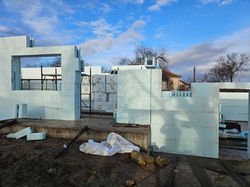
A selection of ICF projects implemented in Canada and Bulgaria – key stages of installation and construction.
| |
|---|---|
| |
| |
|  |
FREQUENTLY ASKED QUESTIONS
1. Which is more cost-effective – ICF or traditional construction (brick, concrete, and insulation)?
If you compare only the price of a pallet of bricks against a pallet of ICF blocks, traditional construction appears cheaper. However, when looking at the total value of a finished wall, the picture changes:
-
Consolidated Processes: With ICF, you get the structure and high-grade insulation in a single step. In traditional construction, you pay separately for masonry, adhesive materials, labor for insulation, and mechanical fastening (doweling).
-
Savings on Finishing Works: Thanks to the precise geometry of blocks with internal webs, walls are straight and ready for a minimal plaster layer or direct drywall application. With brick, deviations often require thick, expensive coats of plaster to "level" the surface.
-
Future Energy Costs: ICF eliminates thermal bridges (points where heat escapes). This is an investment that pays off every month through heating and cooling bills that are drastically lower than those of a standard house.
-
Time is Money: A shorter stay on the construction site means lower overhead costs.
In short, the initial investment in ICF may be slightly higher or comparable to high-quality brick construction, but in the long run, ICF is more cost-effective due to speed, lower finishing costs, and energy savings.
2. Is there a risk of mold? Do the walls "breathe"?
The short answer is: ICF is one of the most effective ways to prevent mold.
-
No Cold Spots, No Mold: Mold grows on cold surfaces where condensation forms. In ICF, the concrete core is insulated on both sides, keeping the interior wall surface warm. This eliminates the "thermal bridges" and moisture that cause mold.
-
The "Breathing" Myth: Modern energy-efficient buildings aim for airtightness to prevent heat loss. "Breathing" through cracks in old-fashioned walls actually leads to drafts and energy waste.
-
Healthy Air: In an ICF home, fresh air is managed through proper ventilation (HRV/ERV systems), not through the walls. This actually protects your home from outside dust, pollen, and allergens.
In short, ICF keeps your walls warm and dry, preventing mold while providing a cleaner, healthier indoor environment.
3. All ICF blocks look the same – does it matter which model you choose?
At first glance, the difference seems to be just the brand, but the real value lies in the "skeleton" inside the expanded polystyrene (EPS). High-end systems use integrated plastic ties (webs) that run through the entire block and lock its two walls firmly in place.
What this means for your project:
-
Precise Rebar Placement: The internal plastic skeleton features factory-installed "chairs" or notches where steel bars snap into place exactly as designed. This ensures the reinforcement stays put during the concrete pour without shifting or sinking.
-
Resistance to Concrete Pressure: These plastic elements are spaced every 20 cm and act as sturdy spacers. They prevent the blocks from "bulging" under the weight of wet concrete, ensuring straight walls and minimizing plaster consumption during finishing.
-
Direct Interior and Facade Mounting: The plastic ties reach nearly to the surface of the foam. They serve as ready-made "studs" for fastening. You can screw drywall, furniture mounts, or facade elements directly into them with a standard screw, without needing to hammer-drill into concrete.
In short, choosing a block with a solid plastic structure is a technical decision that reduces the risk of reinforcement errors and saves time during installation of finishes and furnishings.
4. Is it true that concrete in ICF is not vibrated?
Concrete must be vibrated to remove air pockets and ensure all cavities around the reinforcement and openings are filled. The degree of vibration depends on the quality of the block.
-
The Nuance: Specialized vibrators are used, and the process follows a strictly defined method and tempo.
-
The Risk: Excessive vibration or using the wrong equipment with low-quality blocks can lead to a "blowout" (the formwork bursting).
Here, the contractor's experience is invaluable for achieving a monolithic wall without defects.
5. Can any builder build with ICF?
The technology looks easy (like "Lego"), but it hides specific nuances that require specialized knowledge. An experienced team knows exactly how to level the system and control concrete pressure during the pour.
Important: A lack of experience often leads to bowed walls, which are expensive to correct later with extra layers of plaster or complex drywall frames.
The secret is not just in precise stacking, but in the bracing system. Professional teams use specialized metal braces with screw mechanisms. These allow for fine-tuning the plumb line in real-time, even while the wall is full of wet concrete.
6. Does the type of concrete and stone size matter?
Absolutely. ICF construction requires a specific mix with smaller gravel and a precise consistency. If the concrete is too thick, it won't fill the spaces under windows or around dense steel; if it is too thin, the pressure on the blocks becomes dangerously high.
7. How fast can a floor actually be built?
Under optimal conditions with quality materials, the walls of a standard house (approx. 100 sq.m.) can be erected and ready for the concrete pour in about 2 weeks. While complex designs take longer, the actual process of pouring the concrete usually takes only a few hours.
CONTACTS
Phone: +359 89 986 5618
WhatsApp: +359 88 680 5877
Facebook: www.facebook.com/icfconstructionbulgaria
Instagram: instagram.com/icf.installer.bg
Email: icf.installer.bg@gmail.com
Location: Pomorie, Bulgaria